How much can you earn from selling Webflow templates in 2026?
A realistic breakdown of earnings, timelines, income ranges, and trade-offs, based on real experience creating and selling Webflow templates and building a sustainable income stream over time.
Read the September 2026 update
Update: A lot has changed in the Webflow Template Marketplace since I wrote this article. If you're considering selling Webflow templates today, I recommend reading my September 2026 update.
I’ve been a Webflow template creator for about 1.7 years. In that time, I’ve:
Created 15 templates
Sold 300+ of them
Made $15,000
On the surface, the math looks straightforward. You might think: $15,000 / 15 templates = ~$1,000 per template
So… make a template, earn a thousand dollars. Repeat 15 times. Nice and tidy.
That’s not how it works. Template earnings are shaped by a mix of factors, and they vary between creators, across templates and even over time. That is why:
Some creators consistently earn more than others
Some templates sell well, while others don’t sell at all
Most creators don’t earn much in the beginning, and only see meaningful results if they stay consistent over time
How Webflow template sales usually look at the start
You’ve seen my numbers after 1.7 years, but when I started, they looked very different. When I published my first template, I made roughly $100 in the first month.
Sales were slow and inconsistent, with most of them coming in the first couple of months. After that, they settled into just 2-3 sales per month.
This pattern is common. When you only have one template, income is fragile because there’s no buffer. If that one template doesn’t sell well, there’s nothing else to offset it. Every slow week feels personal, even though it’s often just normal marketplace behavior.
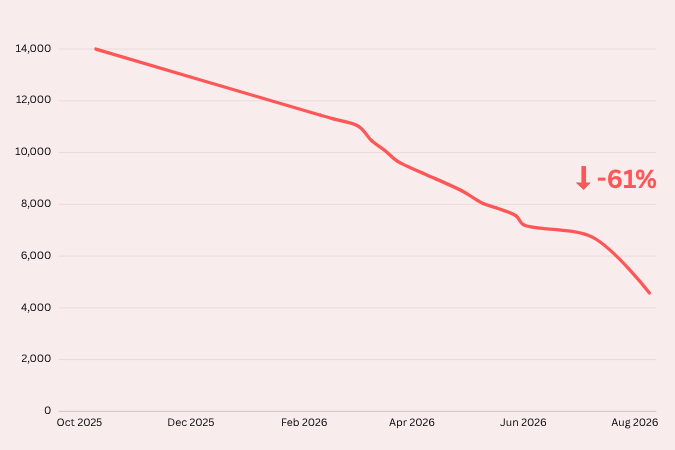
Even if your first template does well, that early performance doesn’t last very long. The fact is, newly published templates tend to perform better early on simply because they appear more prominently at the top of the Webflow Marketplace. So, they get more eyes, attention, and sales. As other newer templates come in, older ones get less visibility and inevitably fewer sales.
The key to growing template income
If you’re counting on one template to make you money forever, you’ll be disappointed because sales tend to slow down after the first 3-4 weeks.
If you want templates to become a real income stream, you need to keep creating and publishing them. Each new template gives you a jump in earnings (because it's new and fresh), while older templates continue contributing in smaller, steadier amounts. On their own, those older templates might not look impressive but, together, they add up.
This isn’t about prioritizing quantity over quality. Subpar designs may not even get accepted by Webflow, and even if they do, they’re unlikely to sell well. What matters instead is applying what you learn from each template release and building a catalog where quality improves over time.
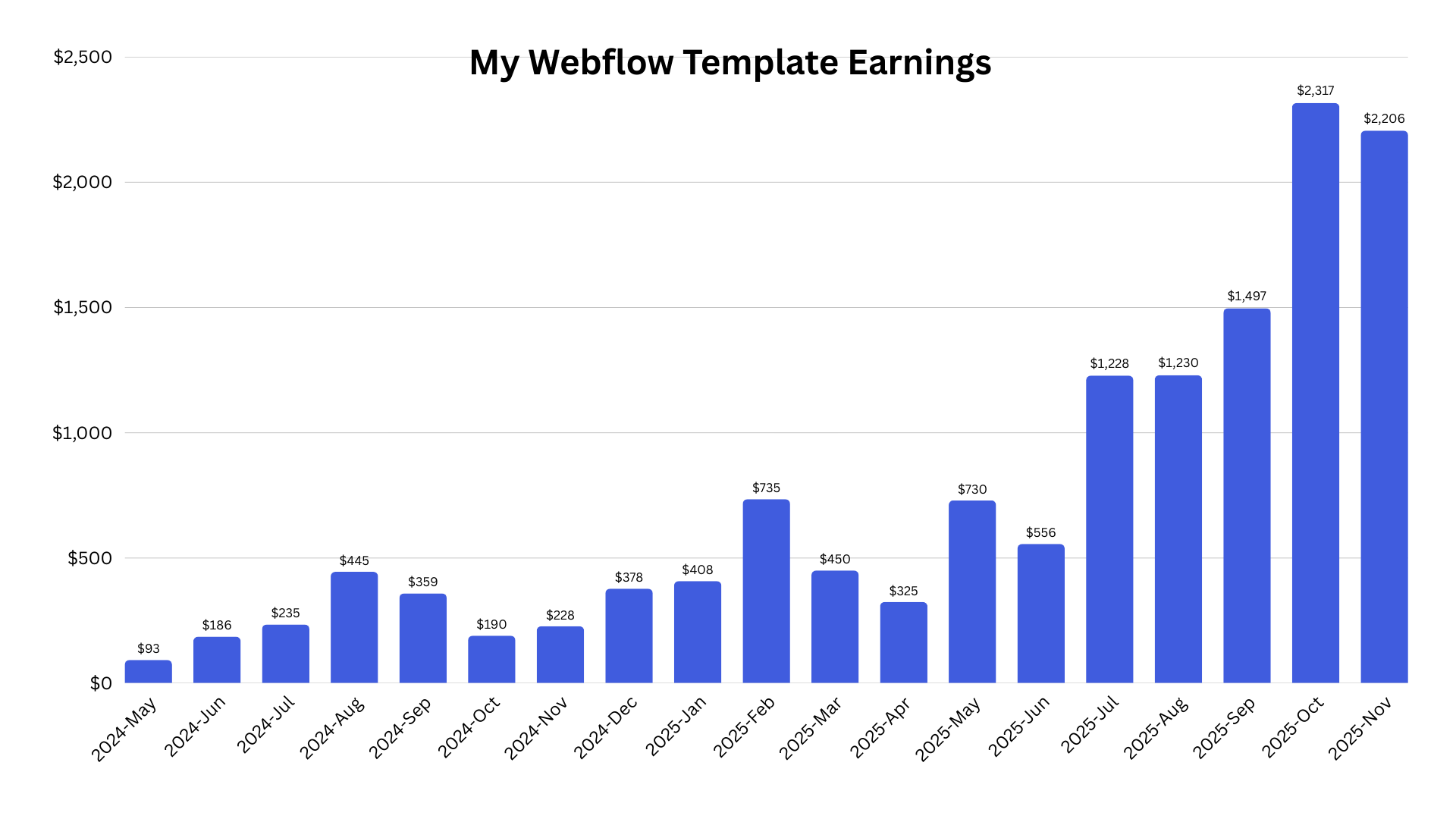
My best month so far has been around $2,300. That wasn’t driven by one breakout template. It came from multiple templates contributing at the same time.
What determines the success of a Webflow template?
One important thing to keep in mind is that not all templates do equally well in terms of sales. For context, here are some numbers:
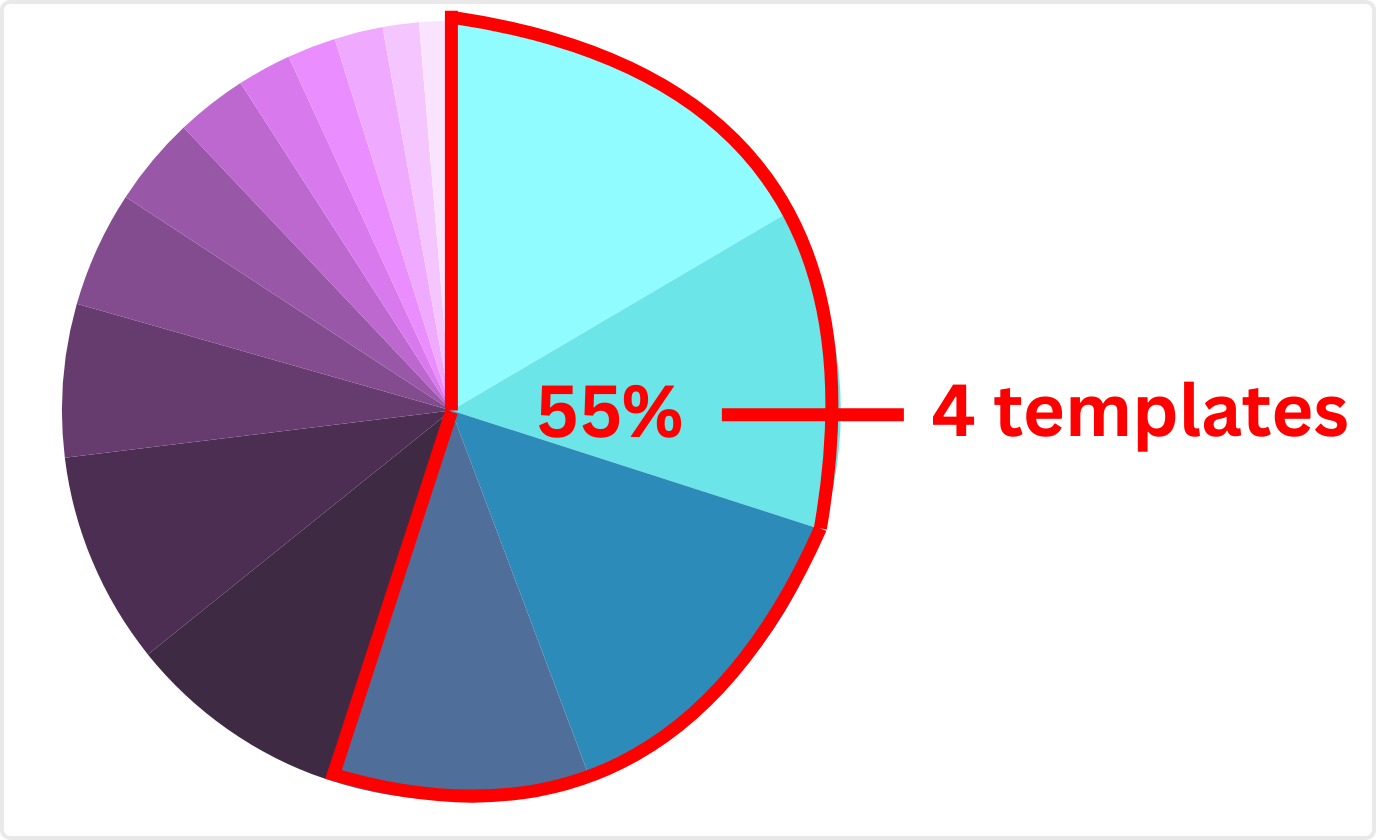
Out of the 15 templates I’ve published so far, just 4 of them account for more than half of my total earnings.
My highest-selling template has made about $2,600 so far.
My lowest-earning one has made just $200.
My earnings per template
So, template income is not spread evenly across everything you publish. Some of your templates will do well and get a lot of sales, some won’t, but when you have multiple templates, that’s when sales of new and old templates, high selling and low selling templates, all start compounding and you start making steady monthly income.
While I don’t have a perfect formula for what makes a Webflow template sell, when I compare my templates that performed well with the ones that didn’t, a few patterns do show up consistently.
1. Category and demand
Some template categories simply have more buyers than others. Categories like SaaS, portfolios, and creative agencies tend to attract more demand because there are far more businesses operating in these spaces.
A well-designed template in a low-demand category will always be capped by how many people are actively searching for it. Templates in higher-demand categories, on the other hand, generally have more room to grow.
The catch here is competition. Because these categories are attractive, they’re also heavily saturated. There are already thousands of templates targeting SaaS, portfolios, and agencies, which means standing out and converting buyers is harder unless you create very high-quality designs.
2. Design quality
A common assumption is that over-the-top animations or visually flashy interactions are what woo buyers and make templates sell. That isn’t exactly true.
The templates that perform better tend to strike a balance: they look polished and professional, but they’re also practical to use, with clear layout hierarchies, sensible page structures, clean spacing and typography, and predictable components that don’t break when content changes.
Most buyers aren’t looking for a design experiment. They’re looking for something they can confidently customize, ship, and maintain without fighting the layout.
3. Industry fit
One pattern that’s been very clear for me: templates perform better when they’re designed for industries I actually understand. Not just visually, but structurally.
This is why I generally recommend creating templates for industries you’re familiar with, rather than picking something random just because it sounds profitable, is trending or because you want to “diversify”.
Early on, I created templates for very different industries (architecture, skincare, recruitment, and others), thinking that spreading myself across categories would increase my chances of sales. In hindsight, that was a mistake.
When you don’t fully understand what businesses in an industry actually need or prioritize, it becomes much harder to create a strong, usable template, no matter how polished it looks. When you understand an industry well, you naturally think about:
How businesses in that industry actually use their website
What content matters most to their clients or customers
Which pages are essential vs optional
What not to include (e.g. features or pages that inflate the template but add no real value)
Realistic earning ranges for template creators
Before getting into numbers, one important caveat: Webflow doesn’t publish creator earnings data, and I obviously can’t see everyone’s dashboards. So this isn’t a prediction or a guarantee. It’s a rough sense of the ranges I’ve seen, based on my own experience and conversations with other template creators.
With that in mind, outcomes tend to fall into a few broad buckets.
Low end ($0 to $500 total)
This usually includes people who publish one template, don’t see much traction early on, and stop there. It doesn’t necessarily mean their template is bad…it often just means they didn’t stay in the game long enough for anything to compound.
Middle ($500 to $3,000 per month)
This is where you’ll find small-to-mid creators like me who publish multiple templates and stick with it. Again, not every template does well, but not every template needs to be a hit. When you have several, the stronger ones cover for the slower performers.
High end ($3,000+ per month and beyond)
These are creators who treat templates as a long-term product business. They publish consistently, analyze what works and what doesn’t, improve with each release, and build trust with a loyal customer base over time. It’s not common, and it doesn’t happen quickly, but it’s very real. They also actively market templates outside the Webflow marketplace.
The important thing is that these ranges aren’t driven by a single template. They’re shaped by how long someone sticks with it, how many solid templates they publish, and whether they approach this as a system rather than a one-off experiment.
Can you make full-time income with Webflow templates?
I believe so, yes. However, it requires treating templates as a long-term product business, not a source of “side income”.
So far, I’ve been creating templates alongside freelance design work. I aim to create and publish one template a month, and over time I’ve seen very encouraging results from that consistency. Enough, in fact, that I’m now planning for templates to eventually replace client work.
Based on my experience so far, getting to that point isn’t about one successful template or a few strong months. It comes down to a shift in how you approach templates and how deliberately you build on what works.
Here are a few things I’ve learned and plan to apply as I work toward making templates a primary income stream.
Studying what works and what doesn’t
Instead of moving on to the next template as soon as you publish one, look closely at how each template performs. Which ones get the most views? Which ones convert into sales? Webflow makes this information available to template creators. Over time, patterns start to emerge, and those patterns should inform what you build next rather than guessing or starting from scratch each time.
Building a marketing system instead of relying solely on organic discovery
Early on, most sales come from marketplace visibility, which you don’t control and which naturally fades over time. To make template income more reliable, you need other ways for people to discover your work. That doesn’t mean running complex marketing campaigns or even paid ads. Simply promoting templates through your own website, content (blog posts or YouTube), social media, email, or even affiliates can make a meaningful difference.
Finding a niche and committing to it
This isn’t about boxing yourself in, but about being recognizable for something. When you design repeatedly for the same type of business or use case, your templates improve faster, buyers know what to expect, and trust builds more naturally than when every template targets a completely different audience. For example, if you consistently create and share SaaS templates, the moment someone needs a SaaS website, they’re far more likely to remember (and buy from) you.
Are Webflow templates good for passive income?
In my opinion, no, Webflow templates are not passive income.
They sit somewhere between active and passive income, but calling them “passive” sets the wrong expectations.
With templates, most of the work is front-loaded. Before a template ever earns anything, you’ve already spent time researching the idea, designing and developing it, and getting it published. That part is very much active work.
Then, there is also some ongoing effort, even if it’s relatively light. Templates need maintenance as Webflow changes and buyers occasionally need support. None of this is overwhelming or even daily tasks, but it’s necessary.
The bigger piece, though, is still marketing.
In theory, templates seem like a product that you can “build once, sell forever”. But, in practice, products don’t usually sell themselves. So, if you want the template you created a year ago to still be selling today, you need to make an effort to actively keep it in front of the right audience.
So no, Webflow templates aren’t passive income. But they are a scalable income stream if you approach them with the right expectations.
How you can build template income in 2026
If you want to turn templates into a real, repeatable income stream, your focus should be on building a system that compounds over time and becomes more predictable with each release. Here’s what that would look like:
Start with one template for an industry you deeply understand
Build a small, focused catalog instead of targeting random industries or chasing trends
Use Webflow’s data to guide what you build next, including insights on industry trends and customer behavior
Not count on templates to “sell themselves” but actively market and promote them in free, low-effort ways
Think of every template as part of a broader plan, not a one-off experiment to “see if it sells.”
If you want a more structured, step-by-step view of how to apply this in practice, I’ve put together a Udemy course that walks through the entire process based on my own experience creating and selling Webflow templates.
Creating and Selling Webflow Templates in 2026
A practical guide to turn your Webflow skills into a product-based income stream.

.webp)